The Art Perspective
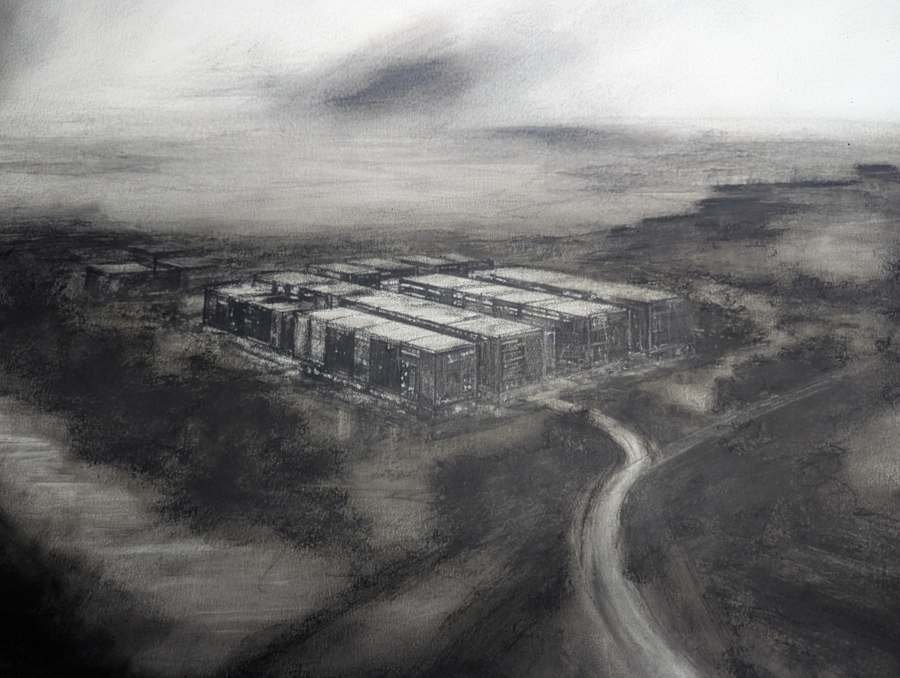
I began this drawing with one question: what would it look like if the digital economy belonged to the landscape, rather than invaded it?
The scene is not imaginary. It is every valley where land, power, and fiber meet. The mist is real. The winding road is real. The building behind it, low, quiet, half-hidden by the tree, is the infrastructure we are fighting over right now. I drew it in charcoal because charcoal is honest: it can be soft, and it can be permanent. It is the right medium for a subject that is both uncertain and inevitable.
For generations, cities and communities grew around the infrastructure that powered each era. Railroads shaped industrial towns. Highways transformed commerce. Airports connected nations. Power plants fueled manufacturing. These projects were rarely invisible. They changed landscapes, sparked debate, and ultimately became part of the foundation of modern life. This art asks us to see the data center as the next of these, still new enough to frighten, still raw enough to shape.
Today, a new kind of infrastructure and Landscape is emerging.
It does not move people or goods. It moves information.
The data center has become the factory of the digital economy, quietly supporting everything from online banking and healthcare to scientific research, education, and artificial intelligence. Every search, every video call, every AI model, and every cloud application ultimately relies on physical buildings filled with servers. But this art does not show servers. It shows the valley that holds them.
The digital world is not floating in the cloud. It is grounded in concrete, steel, fiber, electricity, and land.
As AI accelerates, this infrastructure becomes even more essential. Nations that hope to lead in innovation will need places where computation can happen. Communities that want to participate in tomorrow’s economy will increasingly find themselves connected to this new generation of infrastructure.
The question is not whether we need data centers. It is how we build them well.
For any city or nation to thrive in the digital economy, it needs data centers. They do not have to be in every backyard, but they have to exist. The cloud is not in the sky. Every hospital record, every financial transaction, every small business running online, it all eventually runs on a physical machine in a physical building on physical land.
The challenge is not whether this infrastructure should exist. It is whether we have the imagination to build it in a way that strengthens the communities that host it, rather than simply extracting from them.
The rural opportunity is visible in the art
Some of the most promising sites lie far beyond major cities, where land, renewable energy, and connectivity come together. These places, often overlooked for decades, can become part of a new economic landscape. Construction creates jobs. Long-term operations support local businesses. Infrastructure improvements extend beyond the campus itself. Communities that were once known only by geography may become known for enabling the next generation of innovation.
In many ways, this is not unlike the arrival of railroads, highways, or electrical grids. Infrastructure has always reshaped communities. The opportunity today is to ensure that this transformation reflects the values of our time.
The new landscape can give rural areas an identity, not take one away.
The image of a data center need not be a wall of concrete against the sky. It can be a campus that follows the contours of a valley, a road that welcomes visitors, a place where the digital and the rural sit side by side. The goal is not to hide the infrastructure, but to design it so that the land around it is still recognizable, still loved, and still living. The charcoal is soft, but the idea is this can belong here.
Marrying national need and local benefit
A nation that wants to lead in the digital economy needs places where computation can happen. A community that hosts a data center deserves more than a promise. It deserves a partnership.
That means real and local benefits: good jobs during construction and operations, improved roads and broadband, tax revenue that supports schools and services, investment in clean energy, and a long-term voice in how the facility is run and eventually decommissioned. The community should not be a bystander to a project in its own backyard.
Corporations who build data centers are responding to real demand and trying to deliver the connectivity that modern economies depend on. Communities who ask hard questions are protecting the places they live. Neither is the enemy. Both have a stake in getting this right.
Building responsibly means making promises we can keep.
- Design facilities that respect neighbors, sightlines, and sound.
- Protect water, land, and wildlife through binding commitments.
- Power them with clean, renewable energy wherever possible.
- Listen before designing, and keep listening after construction.
- Share benefits: local hiring, tax revenue, infrastructure, and community funds.
- Measure performance publicly and hold operators accountable.
Technology and sustainability should not compete. They should advance together.
Perhaps the landscape of the future will not be defined only by skylines or factories, but by places where digital infrastructure and environmental stewardship coexist. This art is a proposal for what that coexistence might look like: not a surrender, but a composition.
A question of vision
We have the tools to build data centers that are cleaner, quieter, and more deeply connected to the places that host them. What we need is the will to do it that way from the start—not as a concession to opposition, but as a design principle.
The question is no longer whether society needs data centers. It does. The question is whether we have the vision to build them in a way that future generations will be proud of.
Because every generation inherits the infrastructure built by the one before it.
Ours may be remembered for building the foundation of the AI era. Not only with ambition, but with responsibility—and with the people who live in the new landscape.
The art remains on the wall as a reminder of what that new landscape could feel like: a valley, a road, a quiet building, and the mist rising over all of it, powering the local cities and national economies.
From the Studio
Own the drawing that started this perspective
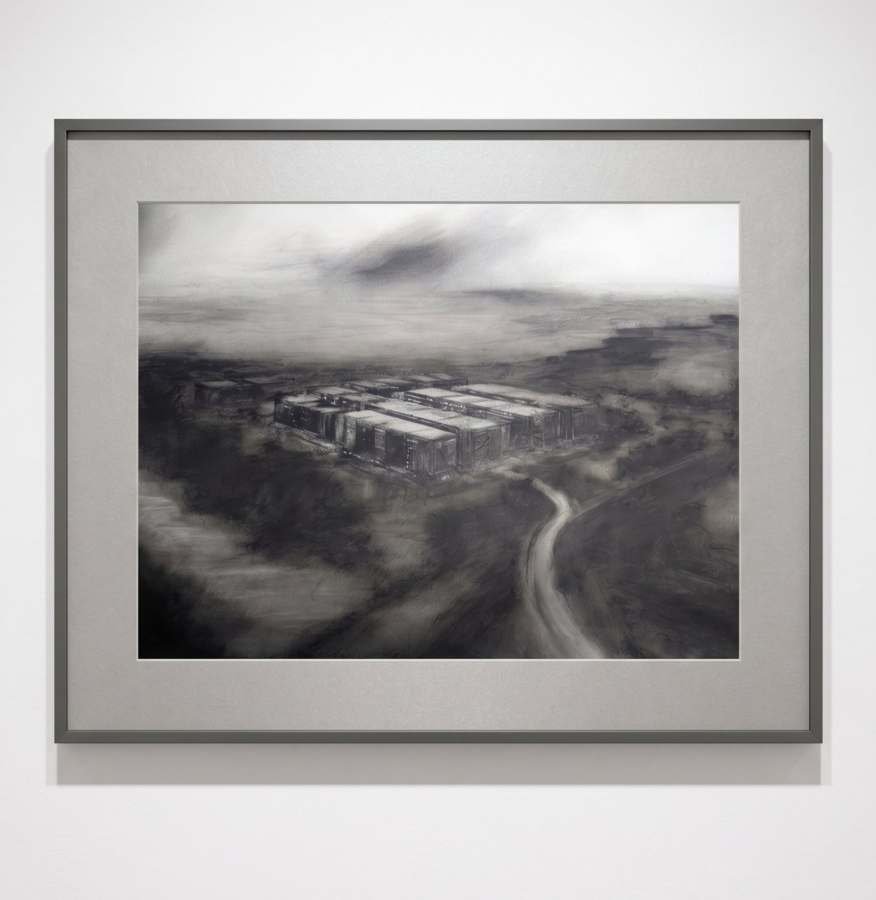
The original carbon artwork shown above is available as a limited edition. Each piece is directly tied to verified positive impact, so the work on your wall is also part of the work being done. The perspective and the drawing are one project.