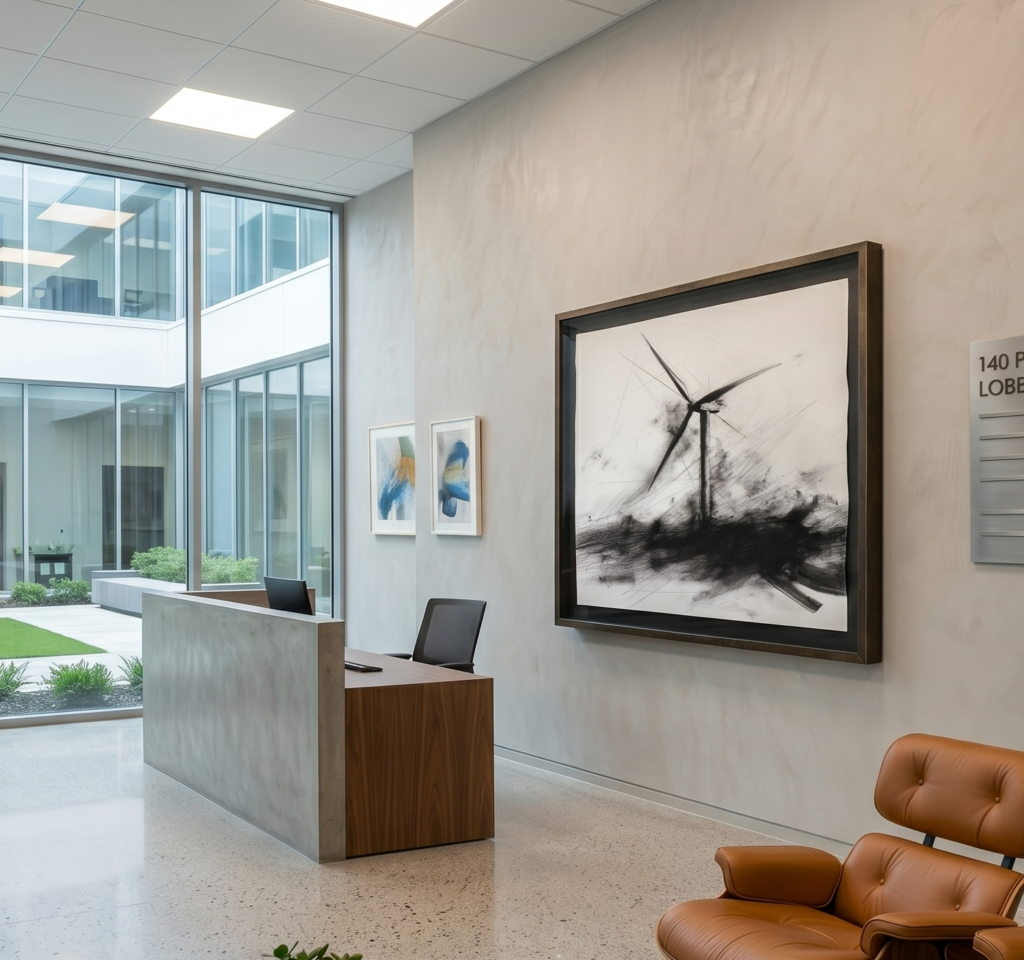
What forward-thinking organizations are doing with their walls, and why it matters more than it sounds
By Abhijeet Shrivastava (Abhi) | thecarbonart.com
I have been in a lot of corporate offices.
And I have noticed something consistent. The walls are full of things that mean nothing. Abstract prints chosen by a facilities team. Photography that could belong to any building in any city. Art that signals “we spent money on this” and nothing else.
That is changing. Slowly, but it is changing.
Companies are starting to ask a different question. Not “what should our spaces look like?” but “what should our spaces stand for?” That shift is small in language and significant in practice. Because when sustainability becomes central to how a company operates, it eventually has to become central to how a company feels. And right now, for most organizations, there is a gap between what they claim on paper and what you experience when you walk through the door.
Climate art is beginning to close that gap.
Here are ten ways companies are actually using it.
1. Making sustainability something people can see every day
Most sustainability work is invisible. It lives in reports, dashboards, and quarterly updates that most employees never read. Companies invest real resources in climate commitments, and those commitments stay buried in PDFs.
Art does not stay buried.
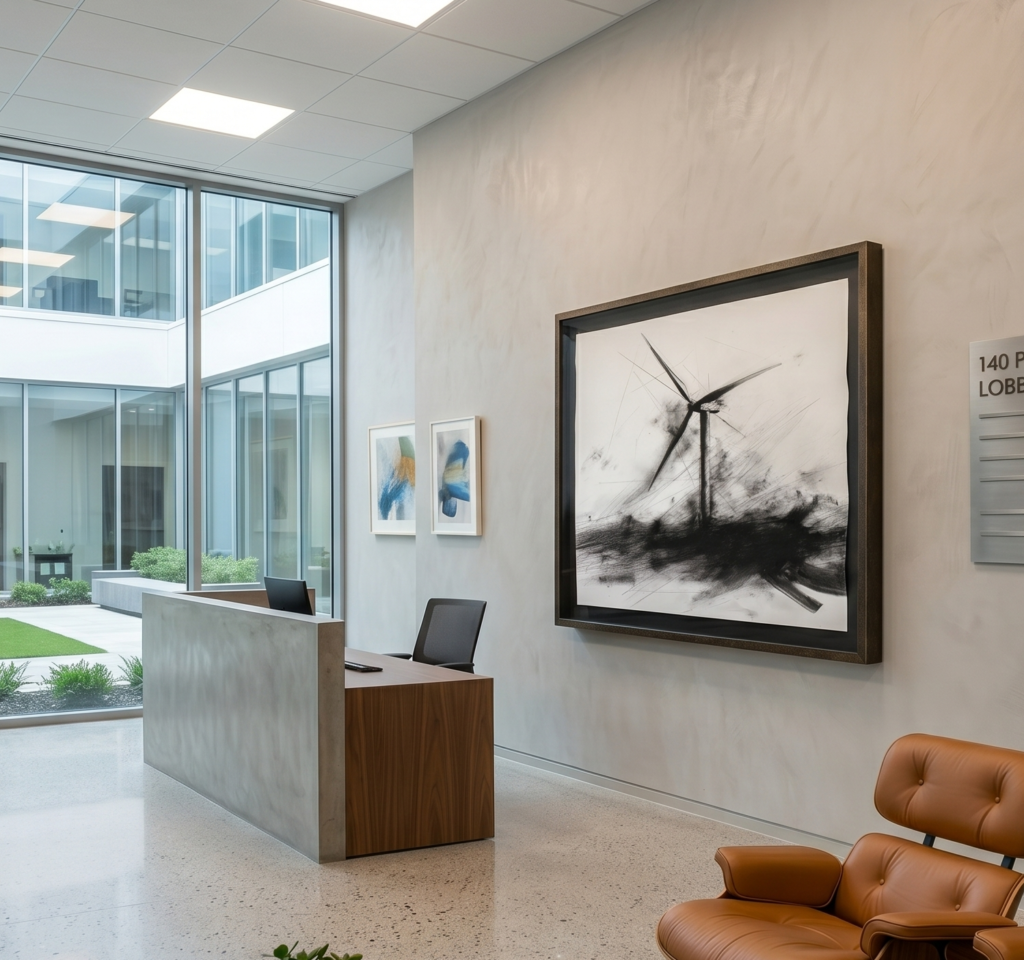
When a piece connected to real environmental action hangs in a space where people work, eat lunch, or wait for a meeting, it becomes part of the daily environment. It does not require anyone to open a document. It just exists. And that consistency of presence does something a report cannot do. It makes the commitment feel real.
2. Setting the tone before a single word is spoken
What someone sees when they walk into your headquarters communicates something before any meeting begins. Before any handshake. Before any slide deck loads.
I have watched this happen with my own work. A piece goes up in a lobby and the conversation changes. Visitors ask questions. Employees stop and look at it differently than they look at generic wall art. Something about knowing the material carries a story shifts how people engage with the space.
For companies investing in sustainability, that first impression is worth thinking about carefully. The physical environment is never neutral.
3. Giving ESG a human face
ESG frameworks are important. They are also largely impossible to feel.
People do not form emotional relationships with metrics. They form relationships with stories, materials, and things they can see and touch. That is not a flaw in human nature. It is just how attention works.
Climate art gives sustainability a face. Not a dashboard face. A human one. When a piece in a boardroom or a common area is connected to regenerative agriculture in Kenya, or carbon stabilization through biochar in Iceland, it gives people something to hold onto. A place. A process. A material.
Abstract climate goals become something you can point to.
4. Building something memorable around Climate Week
A lot of companies host Climate Week events. Most of them follow the same format. Panels. Presentations. A speaker or two. Lunch.
People leave and forget most of it by the following week.
An installation changes that. Not because it is more educational than a panel. Because it is experienced differently. People move around it, photograph it, ask questions, revisit it. The physical experience stays with you in a way that a slide deck does not.
If your goal is for people to actually remember why your climate week mattered, the room needs to feel different, not just sound different.
5. Signaling what kind of future you are building toward
Innovation centers are meant to feel like something. They are supposed to tell people: this is where we think about what comes next.
Most of them look like every other modern office.
Work connected to carbon removal, material innovation, or regenerative systems belongs in these spaces. Not because it is trendy. Because it is genuinely forward-facing. Biochar, for example, is not a legacy material. It is an emerging one. A piece that uses it, and tells that story, fits naturally into a space designed to signal future thinking.
The art and the environment reinforce each other.
6. Rethinking the executive gift
Most corporate gifts communicate nothing except that someone had a budget to fill.
A piece of climate art, connected to a documented environmental outcome, communicates something different. It says: we thought about what you value. It says: this gift did something beyond sitting on a shelf.
For clients, partners, or leadership who are genuinely committed to sustainability, that distinction matters. A gift that carries a Certificate of Climate Impact, tied to a specific regenerative initiative, is not just a gesture. It is a contribution. And it is one they will remember and talk about.
7. Creating spaces that reflect what people actually care about
Employees are paying attention to where they work. Not just the salary. Not just the title. The environment, the culture, the values they are surrounded by every day.
Research on workplace wellbeing is consistent on this. Physical space influences how people feel about their work and their employer. And people increasingly want to work somewhere that takes its environmental responsibility seriously, not just in writing, but in practice. The UN Environment Programme has documented how the built environment shapes both behavior and organizational culture over time.
A purpose-driven space is not decoration. It is a signal. It tells people: we thought about what this place should mean.
8. Strengthening the room during investor conversations
Physical environment is rarely part of investor relations strategy. It probably should be.
When sustainability is central to a company’s growth narrative, the spaces where those conversations happen matter. A boardroom that includes documented climate impact, visible and integrated rather than announced in a brochure, adds a layer of credibility that is hard to manufacture.
It is not about impressing anyone. It is about consistency. If long-term environmental thinking shapes your strategy, it should shape your space.
9. Connecting acquisition to actual environmental outcome
This one matters to me personally, so I want to be specific about it.
Some climate-focused work goes beyond storytelling. Each piece in The Carbon Art collection is connected to documented biochar application on working regenerative farms. Biochar sourcing is verified through Puro.earth and aligned with VCS/Verra standards, with on-the-ground application tracked through PlantVillage+ in Kenya and India. A Certificate of Climate Impact comes with every acquisition. Quantity, location, sourcing chain. Not a pledge. A record.
For companies that need their environmental investments to hold up to scrutiny, that distinction is significant. A verifiable, auditable climate action embedded in an artwork is a different proposition than a sustainability pledge. It is the kind of thing that belongs in an ESG report, not just a press release.
The standards are tightening. What holds up will matter more over time.
10. Building something that outlasts a campaign
Campaigns end. Commitments change. Initiatives get rebranded.
What hangs on a wall stays.
The companies I think about that are doing this well are not using climate art as a moment. They are using it as a foundation. The work becomes part of the culture of the place. People who join years later encounter it and ask questions. It becomes part of how the organization understands itself.
That is what legacy looks like in practice. Not a plaque. Not a webpage. Something that exists in the physical world, holds its story, and keeps telling it.
What this is really about
The question is not whether your company should care about sustainability. Most already do, at least on paper.
The question is whether that care is visible. Whether it is felt. Whether someone walking into your space for the first time would know, without being told, that your organization takes this seriously.
The walls are not separate from the strategy. They are part of it.
For acquisition inquiries or to explore climate art for your organization, visit thecarbonart.com/shop